
RAID Controller for ESXi: VMware ESXi RAID Controller Recommended for VMware Hosts
VMware ESXi requires RAID controllers that are fully supported, stable, and optimized for virtualization workloads. The right controller ensures reliable datastore performance, proper integration with VMware drivers, and protection against disk failures. Using unsupported or consumer‑grade controllers often leads to compatibility issues, degraded performance, or even data loss.
This article outlines recommended RAID controllers for ESXi, focusing on models that deliver proven reliability, strong VMware compatibility, and the performance needed for production environments.
Why RAID Controller Choice Matters for VMware ESXi
ESXi Storage Architecture and VMFS Dependency
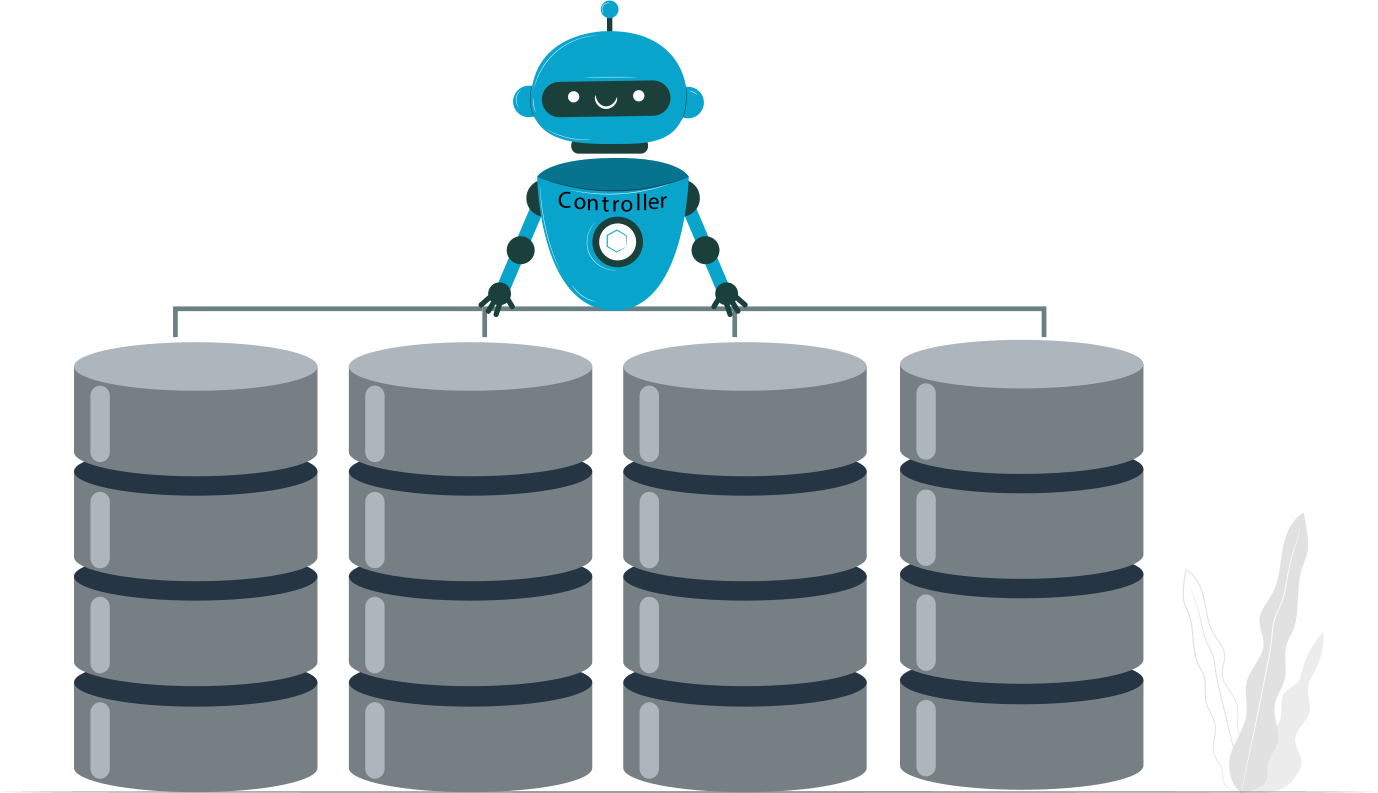
VMware ESXi relies on VMFS (Virtual Machine File System) to manage datastores across multiple disks. VMFS performance and reliability are directly tied to how the RAID controller presents and manages physical drives. A controller with proper VMware driver support ensures stable datastore access, efficient caching, and predictable I/O behavior.
Impact of RAID Controller Quality on Host Stability
A high‑quality RAID controller reduces risks of latency spikes, driver conflicts, and unexpected host crashes. Enterprise‑grade controllers with battery‑backed cache and firmware tuned for virtualization workloads provide consistent throughput and protect against data corruption during power loss or hardware faults.
Common Mistakes When Selecting RAID Hardware for ESXi
- Using desktop‑class controllers: Consumer RAID or “fake RAID” solutions often lack VMware driver support, leading to instability.
- Ignoring compatibility lists: Controllers not on VMware’s Hardware Compatibility Guide (HCL) may work initially but fail after updates.
- Overlooking cache and firmware features: Controllers without proper write‑back cache or firmware updates can bottleneck performance and compromise data integrity.
ESXi Compatible RAID Controller: Core Compatibility Requirements
VMware Hardware Compatibility List (HCL)
Compliance with VMware’s Hardware Compatibility List (HCL) is non‑negotiable. Controllers not listed may appear functional but often fail after ESXi updates or under heavy load. The HCL ensures that the RAID controller has been tested for stability, performance, and integration with VMware’s storage stack.
- Driver lifecycle alignment: Each ESXi release requires matching drivers and firmware. Unsupported controllers can break after upgrades, leaving datastores inaccessible.
- Version consistency: Administrators must verify that both the controller model and firmware version are explicitly listed for the ESXi version in use.
Native Drivers vs. Vendor VIBs
VMware ESXi includes native inbox drivers for many enterprise RAID controllers. These drivers benefit from long‑term support and are updated alongside ESXi releases, reducing compatibility risks.
- Native inbox drivers: Preferred for stability and lifecycle support. They are tested directly by VMware and included in ESXi builds.
- Vendor VIBs (vSphere Installation Bundles): While sometimes necessary for newer hardware, they carry risks if unsigned, deprecated, or poorly maintained. Using outdated VIBs can lead to instability, unsupported configurations, or failed upgrades.
RAID Controller for VMware Hosts: Hardware RAID vs. HBA
Hardware RAID Controllers in ESXi
Enterprise RAID controllers provide dedicated hardware resources such as cache modules, XOR engines, and deep queue handling. These features offload parity calculations and write operations from the CPU, ensuring predictable performance under heavy VM workloads.
- Dedicated cache: Battery‑backed or flash‑backed cache accelerates writes and protects against power loss.
- XOR engines: Hardware parity calculations reduce CPU overhead, critical for RAID 5/6 arrays.
- Queue depth: High queue depth allows multiple concurrent I/O requests, improving VM responsiveness.
Advantages: Hardware RAID offload ensures stable throughput, reduced latency, and consistent performance for production ESXi environments.
HBA Controllers and Software‑Defined Storage
Host Bus Adapters (HBAs) operate in pass‑through or IT mode, exposing individual drives directly to the hypervisor. This approach is often used in software‑defined storage solutions.
- Pass‑through scenarios: HBAs allow ESXi or guest OS to manage disks directly, useful for ZFS, vSAN, or software RAID.
- Software RAID trade‑offs: While flexible, software RAID depends on host CPU and memory, which can introduce overhead. Performance and reliability vary depending on workload and tuning.
- Advantages: HBAs provide maximum flexibility for advanced storage stacks.
- Limitations: Without hardware offload, administrators must rely on software layers for redundancy and caching, which may not match the stability of enterprise RAID controllers.
VMware ESXi RAID Controller Recommended by Use Case
RAID Controllers for Small ESXi Hosts
For lab setups, test environments, or small business hosts, entry‑level hardware RAID controllers can be sufficient.
- Entry‑level hardware RAID: Basic controllers with limited cache and single‑core processors provide redundancy without the cost of enterprise models.
- Constraints in lab/test environments: These controllers are acceptable for non‑critical workloads, but they often lack advanced firmware maturity, deep queue depth, and cache protection. Performance may degrade under heavy VM density or mixed I/O patterns.
Recommendation: Use budget RAID controllers only in non‑production scenarios where downtime or reduced performance is tolerable.
RAID Controllers for Enterprise VMware Hosts
Production ESXi clusters demand enterprise‑grade RAID controllers with robust hardware acceleration and proven firmware stability.
- Dual‑core RAID processors: Modern enterprise controllers feature multi‑core RAID engines that handle parity calculations and I/O scheduling efficiently, ensuring consistent performance across large VM workloads.
- Cache protection: Battery‑backed or flash‑backed cache modules safeguard write operations during power loss, preventing data corruption.
- Firmware maturity: Enterprise controllers benefit from long development cycles, stable driver support, and alignment with VMware’s HCL, reducing risks during ESXi upgrades.
Recommendation: For mission‑critical VMware hosts, prioritize controllers from established vendors (e.g., Dell PERC, HPE Smart Array, LSI/Broadcom MegaRAID) with cache protection and verified HCL compliance.
Best RAID Controller Types for ESXi Workloads
RAID 10 Controllers for Performance‑Critical VMs
RAID 10 combines mirroring and striping, delivering both redundancy and high I/O throughput. For VMware hosts running database servers, transactional systems, or latency‑sensitive applications, RAID 10 controllers are the preferred choice.
- Database and transactional workloads: RAID 10 minimizes write penalties by avoiding parity calculations, making it ideal for workloads with heavy random writes.
- Write latency considerations: With dedicated cache and hardware XOR engines, RAID 10 controllers ensure low write latency and consistent performance under concurrent VM operations.
Recommendation: Use enterprise RAID controllers with strong cache protection to maximize RAID 10 efficiency in production ESXi environments.
RAID 5 and RAID 6 Controllers for Capacity‑Focused Hosts
RAID 5 and RAID 6 provide larger usable capacity by leveraging parity, making them suitable for hosts prioritizing storage density over raw performance.
- Parity overhead under ESXi: RAID 5/6 introduces write penalties due to parity calculations, which can impact VM performance if the controller lacks hardware acceleration.
- Rebuild time and risk exposure: RAID 5 arrays are vulnerable during rebuilds, while RAID 6 offers additional fault tolerance at the cost of higher parity overhead. Enterprise controllers with dual‑core RAID processors and deep queue depth mitigate these risks.
Recommendation: For capacity‑focused VMware hosts, select RAID controllers with robust parity offload engines and verified VMware HCL support to balance storage efficiency with reliability.
Comparison Table: RAID Controller Options for ESXi
| Controller Type | ESXi Support | RAID Levels | Performance | Recommended Use |
|---|---|---|---|---|
| Hardware RAID (Enterprise) | Full (HCL) | 0/1/5/6/10 | High | Production VMware hosts |
| Hardware RAID (Entry-Level) | Partial | 0/1/10 | Medium | SMB / lab |
| HBA (IT Mode) | Full | Software-defined | Variable | ZFS, vSAN |
| Fake RAID / BIOS RAID | No | Limited | Low | Not recommended |
RAID Controller Features That Matter in ESXi
Cache, BBU, and Flash‑Backed Write Cache
Enterprise RAID controllers rely on cache modules to accelerate write operations and protect data integrity.
- Power loss protection: Battery Backup Units (BBUs) or flash‑backed write cache modules ensure that pending writes are preserved during unexpected shutdowns, preventing corruption.
- Write acknowledgment integrity: Controllers with protected cache can safely acknowledge writes to the hypervisor before committing them to disk, maintaining performance without sacrificing reliability.
Monitoring and Management in vSphere
Visibility into RAID health is essential for proactive maintenance and minimizing downtime.
CIM providers and health alerts: VMware ESXi integrates with Common Information Model (CIM) providers supplied by RAID vendors, enabling hardware health monitoring directly in vSphere.
RAID status visibility in ESXi: Properly supported controllers expose array status, cache health, and predictive failure alerts within the vSphere client, allowing administrators to respond quickly to issues before they impact VM workloads.
RAID Controller Performance and ESXi Stability Risks
Firmware Mismatch and Silent Failures
Firmware and driver mismatches are one of the most common causes of instability in VMware hosts.
- ESXi upgrades breaking RAID visibility: When ESXi is updated, unsupported firmware can cause the RAID controller to disappear from the host, leaving datastores inaccessible.
- Vendor firmware lag: RAID vendors often release firmware updates later than VMware’s ESXi patches, creating a gap where controllers may operate in an unsupported state. This lag increases the risk of silent failures and degraded performance.
Rebuild Impact on Virtual Machines
Disk rebuilds place heavy stress on RAID controllers and can severely impact VM performance.
- IOPS collapse during rebuild: When a drive fails, the controller must reconstruct data from parity or mirrors. This process consumes I/O bandwidth, often reducing available IOPS for running VMs.
- VM performance degradation: During rebuilds, latency spikes and throughput drops can affect critical workloads, leading to application slowdowns or even service interruptions. Enterprise controllers with deep queue depth and strong cache management mitigate—but do not eliminate—these risks.
RAID Recovery Considerations for VMware ESXi Hosts

Common RAID Failure Scenarios in ESXi
RAID controllers in VMware environments can fail in several ways, each with serious implications for VMFS datastores:
- Controller failure: A dead controller can render all attached arrays inaccessible until replaced or reconstructed.
- Cache corruption: Damaged or unprotected cache modules may acknowledge writes that were never committed, leading to VMFS corruption.
- Multiple disk drop‑out: Simultaneous drive failures or false drop‑outs can break RAID consistency, leaving ESXi unable to mount datastores.
Why Rebuilding RAID Can Destroy VMFS Data
Traditional RAID rebuilds often overwrite existing disk structures, which can irreversibly damage VMFS volumes.
- Incorrect disk order: If drives are re‑added in the wrong sequence, the controller may rebuild with mismatched metadata.
- Parity misalignment: Rebuilds can miscalculate parity blocks, corrupting VMFS and making virtual machines unrecoverable.
Key point: Attempting a rebuild without proper analysis risks permanent data loss.
Example: RAID Recovery with DiskInternals
DiskInternals RAID Recovery software provides a safer alternative to hardware rebuilds.
- Logical RAID reconstruction without rebuild: The software analyzes disk metadata to reconstruct the array virtually, avoiding destructive writes.
- Support for damaged RAID arrays and VMFS volumes: It can recover data even when the controller, cache, or multiple disks have failed, preserving VMFS structures for VM recovery.
- Use case: Administrators can mount reconstructed arrays and extract VMFS data without relying on risky hardware rebuilds.
Ready to get your data back?
To recover data from a RAID disk (documents, databases, images, videos, and other files from your RAID 0, RAID 1, 0+1, 1+0, 1E, RAID 4, RAID 5, 50, 5EE, 5R, RAID 6, RAID 60, RAIDZ, RAIDZ2, and JBOD), press the FREE DOWNLOAD button to get the latest version of DiskInternals RAID Recovery® and begin the step-by-step recovery process. You can preview all recovered files absolutely for free. To check the current prices, please press the Get Prices button. If you need any assistance, please feel free to contact Technical Support. The team is here to help you get your data back!
RAID Controller for ESXi: Best Practices Summary
- Always validate against VMware HCL. Confirm controller model, firmware, and driver versions are listed in VMware’s Hardware Compatibility Guide before deployment.
- Prefer enterprise hardware RAID for production. Controllers with dedicated cache, dual‑core RAID processors, and proven firmware maturity deliver stability and performance for mission‑critical workloads.
- Avoid consumer and fake RAID solutions. Desktop‑class or software‑assisted RAID controllers often lack proper VMware driver support, leading to instability and potential data loss.
- Plan recovery before failure occurs. Document recovery workflows, maintain firmware backups, and consider logical recovery tools to avoid destructive rebuilds in case of RAID failure.
Final Recommendation: Is a RAID Controller Worth It for ESXi?
When Hardware RAID Is the Correct Choice
Hardware RAID controllers are the right fit for production VMware hosts where stability, predictable performance, and data protection are critical.
- Enterprise workloads with high VM density
- Datastores requiring consistent throughput and low latency
- Environments where cache protection and firmware maturity reduce operational risk
When HBA or Software‑Defined Storage Wins
Host Bus Adapters (HBAs) or pass‑through controllers are better suited for modern software‑defined storage stacks.
- VMware vSAN, ZFS, or other software RAID solutions
- Scenarios where flexibility and direct disk visibility outweigh hardware offload
- Lab or test environments where cost efficiency is prioritized over performance guarantees
Long‑Term Cost vs. Operational Risk
The choice comes down to balancing upfront investment against potential downtime and data loss.
- Hardware RAID: Higher cost, but reduced risk of instability and rebuild‑related VMFS corruption.
- HBA/Software RAID: Lower cost and greater flexibility, but higher reliance on host resources and careful tuning.
Recommendation: For mission‑critical ESXi deployments, enterprise hardware RAID remains the safer long‑term investment. For software‑defined storage projects or non‑production hosts, HBAs provide flexibility at a lower cost.